
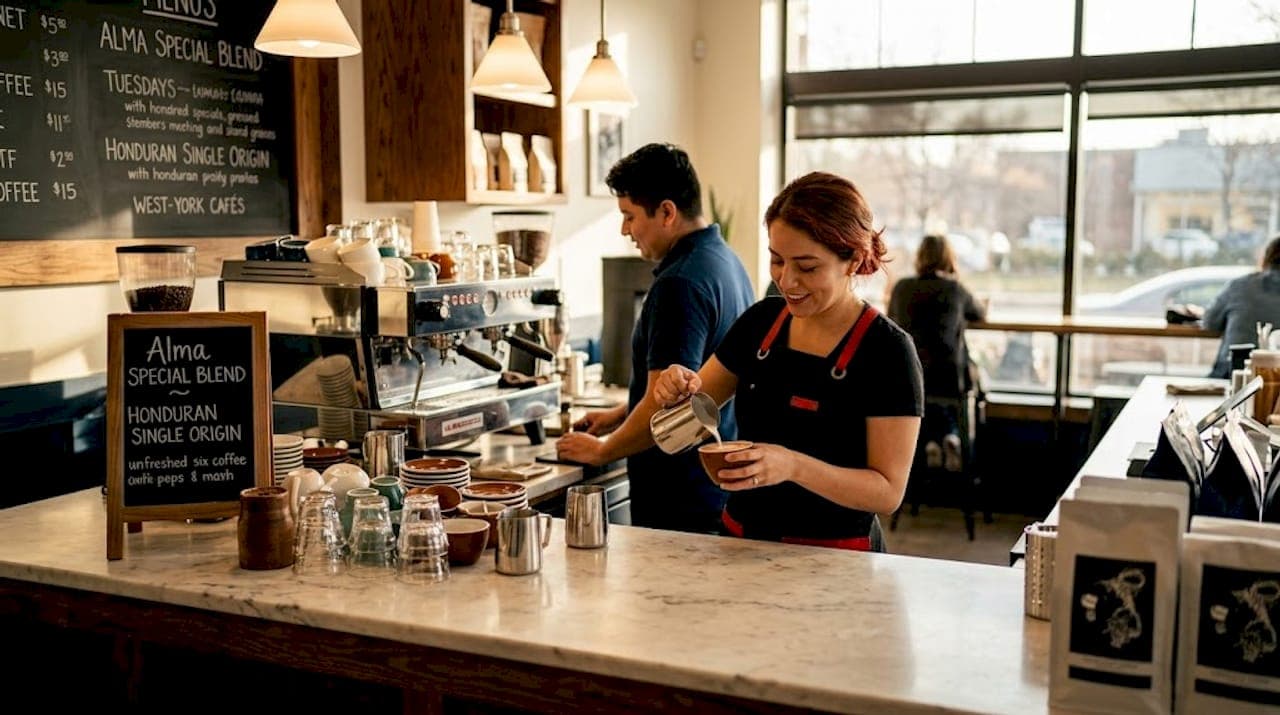
Walk into any great cafe and the coffee bar looks effortless. The drinks arrive fast, the barista barely seems to move, and the whole operation hums. But understanding how a coffee bar works in a cafe reveals something most customers never see: a precisely designed system where every piece of equipment, every staff role, and every square foot of counter space has a specific job. Whether you want to work behind the bar or simply appreciate what goes into your morning cup, knowing how coffee bars function changes how you experience them entirely.
Table of Contents
- Key takeaways
- How a coffee bar operates step by step
- Essential equipment and what it actually costs
- Coffee bar layout and the logic of space
- Staffing, scheduling, and customer flow
- What makes a modern coffee bar more than a machine
- My take on what most people get wrong about coffee bars
- Experience a coffee bar that gets it right
- FAQ
Key takeaways
| Point | Details |
|---|---|
| Workflow flows forward | A coffee bar is built so each step moves forward without backtracking, keeping drinks fast and accurate. |
| Equipment placement is strategic | Grinders, espresso machines, and milk stations must be arranged in exact preparation sequence to avoid bottlenecks. |
| Labor is the biggest variable | Successful cafes target 25 to 35% of revenue in labor costs by scheduling staff to match demand peaks. |
| Layout scales with volume | Small, medium, and high-volume cafes each need different spatial strategies to support barista movement. |
| Experience drives loyalty | Modern coffee bars succeed when they combine operational efficiency with atmosphere and community connection. |
How a coffee bar operates step by step
The foundation of how a coffee bar works in a cafe is a single idea: forward movement. Every step in the process follows the previous one without the barista doubling back. That sounds simple, but it is the reason a well-run bar can produce sixty drinks an hour while a poorly designed one struggles at twenty.
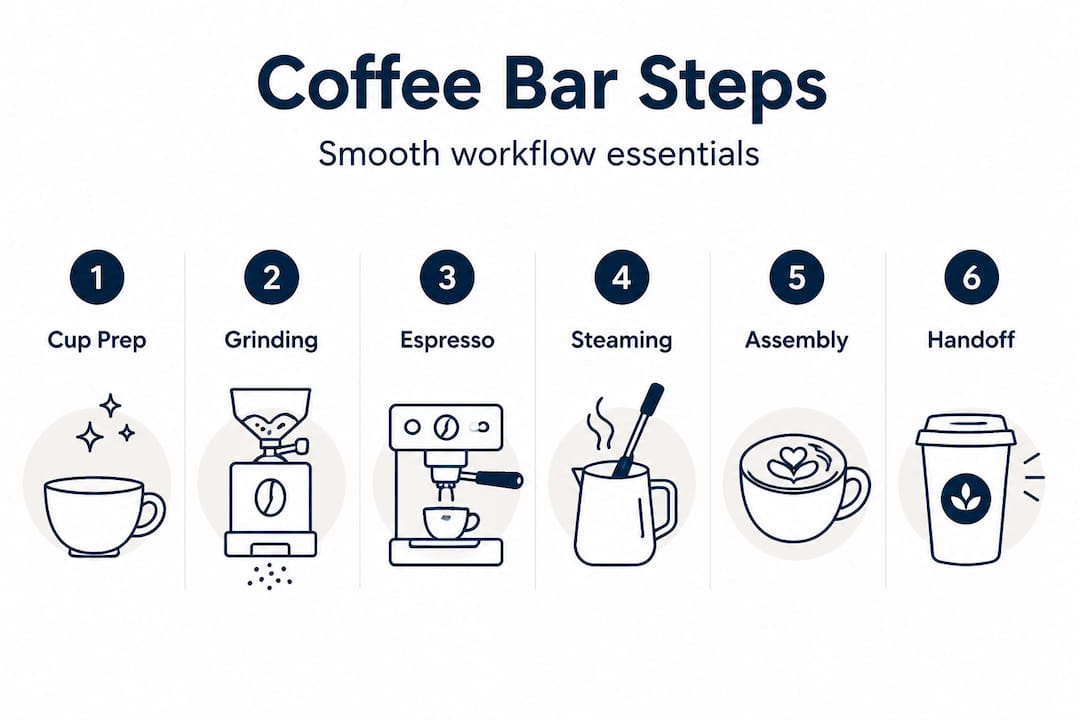
Here is the core sequence:
- Cup selection. The barista grabs the correct cup size based on the order. Cup stacks are positioned at the very start of the bar, not in the middle.
- Grinding. Beans are dosed and ground fresh for each espresso shot. The grinder sits directly next to the espresso machine so the barista never crosses steps.
- Espresso extraction. The portafilter is filled, tamped, and locked into the group head. The shot pulls while the barista moves to the next task.
- Milk steaming. While the shot runs, the barista pitches milk and steams it to the right temperature and texture. This parallel action is where speed actually comes from.
- Drink assembly. Espresso and milk combine in the cup. Syrups or toppings get added at this station, not scattered across the bar.
- Handoff. The finished drink moves to a clearly marked pickup spot. Customers know exactly where to go, and the barista never walks a drink to the customer.
In a two-barista setup, role division prevents overlap during busy periods. One person handles espresso and grinding; the other manages milk, assembly, and handoff. Clear zones eliminate the hesitation that costs seconds on every drink.
Pro Tip: Before opening day, simulate 10 to 20 drink orders with two or three baristas in a mock rush. You will find friction points you never imagined on paper.
Essential equipment and what it actually costs
The equipment in a cafe coffee bar setup is not just a shopping list. Each piece has a functional relationship with the ones around it, and the quality of that relationship determines your drink output and consistency.
Here is what every functional coffee bar requires:
- Espresso machine. This is the centerpiece. Commercial machines cost between $5,000 and $20,000 depending on group heads, steam wands, and automation level. A two-group machine handles moderate volume; a three-group machine supports high-volume service.
- Grinders. You need at least two: one dedicated to espresso and one for batch brew or pour-over. Using the same grinder for both compromises the grind setting and slows you down during a rush.
- Water filtration system. Proper water filtration protects your espresso machine from scale buildup and directly affects flavor consistency. This is frequently the first thing budget-conscious owners cut and the first thing they regret.
- Milk station. Pitchers, a dedicated steam wand thermometer, a drip tray, and a nearby fridge keep this area clean and fast.
- POS system. A well-placed point-of-sale terminal feeds orders directly to the bar without the barista having to turn around or ask a customer to repeat themselves.
| Equipment | Typical cost | Primary function |
|---|---|---|
| Espresso machine | $5,000–$20,000 | Core espresso extraction |
| Grinders (x2) | $800–$2,500 each | Espresso and batch brew |
| Water filtration | $300–$1,000 | Machine health and taste |
| POS system | $500–$2,000 | Order management and flow |
| Milk station setup | $200–$600 | Steaming and assembly |
Pro Tip: Sketch equipment dimensions on your actual floor plan before purchasing anything. A machine that does not leave room for the grinder beside it defeats its own purpose.
Coffee bar layout and the logic of space
Layout is where most new cafe owners make expensive mistakes. The concept that holds everything together is the one-line workflow: order, pay, make, handoff. Each station follows the next in physical space. A customer who orders at the left end of the bar should pick up at the right end. The barista never crosses that line going backward.
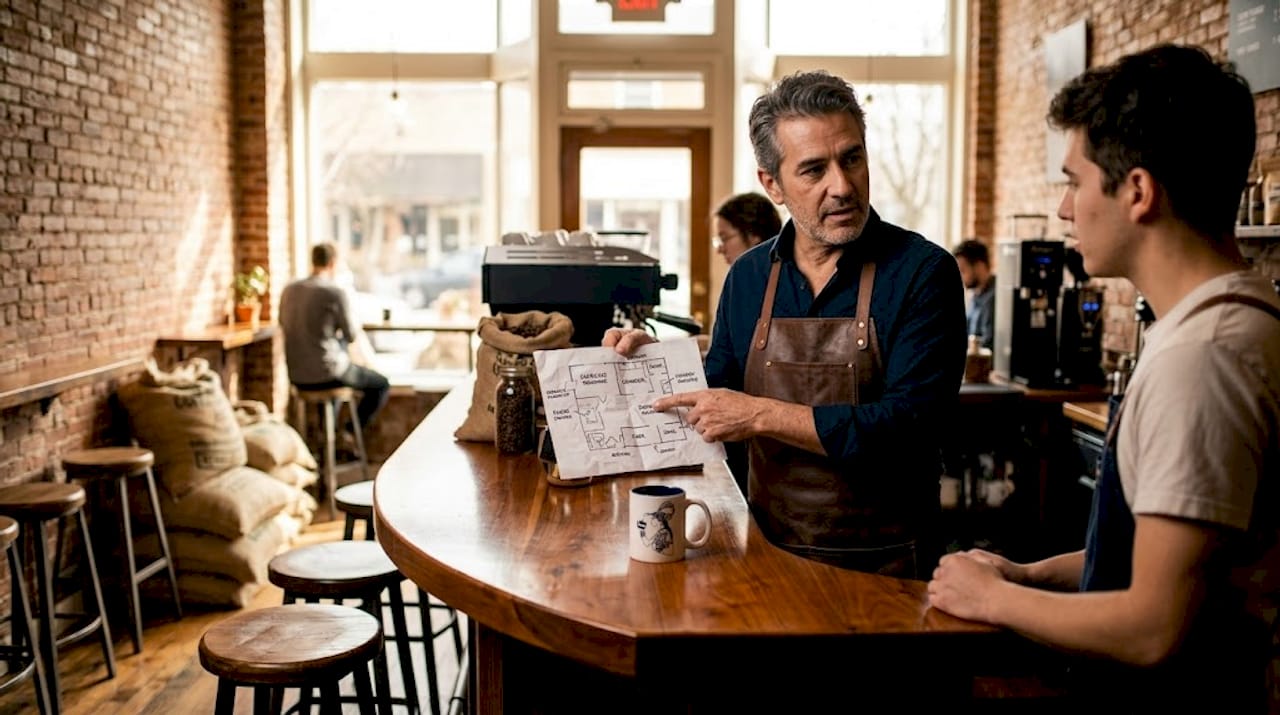
The practical benefit goes beyond speed. When the bar is laid out linearly, two baristas can work simultaneously without colliding. Each person owns a zone. Confusion and miscommunication drop significantly.
Space requirements shift based on volume:
| Cafe type | Counter length | Baristas per shift | Key layout priority |
|---|---|---|---|
| Small, low-volume | 8 to 10 feet | 1 to 2 | Compact linear setup |
| Medium volume | 12 to 15 feet | 2 to 3 | Defined espresso and milk zones |
| High-volume, busy service | 16 to 20 feet | 3 to 4 | Parallel prep zones, dual grinders |
The handoff area deserves specific attention. It needs to be physically separated from the order point so customers waiting for drinks do not crowd the register. That separation alone reduces the visual chaos that makes a cafe feel disorganized even when the coffee is excellent.
Pro Tip: Place your most-used tools within a natural arm's reach of where you stand at the espresso machine. Reaching across or turning around for a tamper or portafilter adds up to dozens of wasted movements per hour.
Staffing, scheduling, and customer flow
Running a coffee bar well is as much about people management as equipment. Labor is the largest controllable expense in any cafe, and successful operations target 25 to 35% of total revenue in labor costs. Getting there requires scheduling that matches staff levels to actual demand rather than guessing.
Most cafes see roughly 60% of their sales between 7 and 10 AM. That means your strongest barista team should be on the floor during those three hours, not split evenly across a ten-hour day. Overstaffing at noon to compensate for being understaffed at 8 AM is a common and costly pattern.
Beyond scheduling, the biggest operational mistakes that slow down a coffee bar tend to fall into a few categories:
- Unclear handoff zones. When customers are not sure where to wait for their drinks, they hover near the bar, creating congestion that physically slows the barista down.
- Undertrained staff. Investing in barista training does more than improve drink quality. It directly impacts customer interaction and loyalty in ways that marketing dollars cannot replicate.
- Role ambiguity during rushes. When two baristas both reach for the same order or hesitate because neither owns the task, seconds stack into minutes.
Pro Tip: Post a simple visual role chart behind the bar during busy shifts. Something as basic as "you own espresso, you own milk" removes the micro-decisions that eat into speed during peak service.
What makes a modern coffee bar more than a machine
Understanding why coffee bar setups enhance cafe experience requires looking past the equipment. The most memorable coffee bars are not the ones with the most expensive machines. They are the ones where the operation feels unhurried and the staff actually communicates.
Experiential coffee offerings like coffee omakase, where customers receive a curated multi-course coffee experience, are growing because they position the bar as a destination rather than a transaction point. You do not need to run a tasting menu to apply the same principle. A barista who makes brief, genuine eye contact while pulling your shot creates a moment that differs from a barista who never looks up.
"A cozy cafe environment is defined by unhurried service and clear communication, allowing customers to feel relaxed and engaged." Comfort is not just about furniture. It is a product of operational confidence.
Specialty coffee shops become community hubs when their identity extends beyond the cup to atmosphere and service. Retail offerings like single-origin bags, branded merchandise, and community events extend that identity further. They also generate revenue on days when foot traffic is slow. The operational backbone that makes this work is the same disciplined workflow that makes a great morning rush possible. You can see how brunch builds that community dynamic in cafes that do it well, where the coffee bar anchors an experience larger than any single drink.
My take on what most people get wrong about coffee bars
I've spent a lot of time in cafes on both sides of the counter, and the most consistent misconception I see is that coffee quality is primarily a matter of skill. It is not. Skill matters, but workflow design is what allows skill to show up consistently at 8:15 on a Tuesday when eighteen people are waiting.
What I've learned is that baristas are often blamed for slow service when the real problem is a layout that forces them to backtrack or a schedule that puts one person on the bar during the busiest window. You can have a technically gifted barista completely undermined by a poorly arranged counter.
The other thing that surprises people: customer flow has a direct and measurable impact on the perceived quality of the coffee. A drink that arrives in 90 seconds from a calm, organized bar feels better than the same drink arriving in 2 minutes from a chaotic one. The operational setup shapes the emotional experience before the first sip.
My honest advice for anyone looking to understand or run a coffee bar: treat the layout and workflow as the foundation for everything else. The pastries on your morning menu, the training you invest in, the atmosphere you build. None of it reaches its potential if the bar itself is fighting the barista instead of helping them.
— Melissa
Experience a coffee bar that gets it right
At Eatalmanola's Alma Café, the coffee bar is not an afterthought. It is built into the rhythm of a space that runs from early morning espresso service through evening cocktails without losing a beat. Every carefully crafted espresso drink reflects the same operational thinking this article describes: forward workflow, clear roles, and a bar setup designed to let the barista do their best work. Explore the full Alma Café menu to see how specialty coffee sits alongside modern Honduran cuisine in a cafe that treats every cup as part of a larger experience. If you are planning something more personal, private dining at Alma extends that community-centered cafe culture into an intimate setting.
FAQ
What is the basic workflow of a coffee bar?
A coffee bar follows a forward-moving sequence: cup selection, grinding, espresso extraction, milk steaming, drink assembly, and handoff. Each step flows into the next without the barista backtracking, which keeps speed high and errors low.
How much does it cost to set up a cafe coffee bar?
The espresso machine alone costs between $5,000 and $20,000 for a commercial unit. Adding grinders, water filtration, a POS system, and milk station equipment typically brings a basic cafe coffee bar setup to $10,000 or more before furniture or build-out.
What are the main responsibilities of a cafe barista?
A cafe barista manages espresso extraction, milk steaming, drink assembly, and customer handoff. In multi-barista setups, roles are divided by zone to prevent overlap and maintain speed during busy service periods.
How does layout affect coffee bar efficiency?
Layout determines how far a barista must move between each step. A linear, one-line layout where order, preparation, and handoff flow in one direction reduces wasted movement and allows two baristas to work simultaneously without interfering with each other.
How do coffee bars build customer loyalty beyond the drink itself?
Operational confidence creates an atmosphere of calm, clear service that customers feel even before they taste the coffee. Experiential offerings, community events, and consistent staff communication extend loyalty well past the transaction itself.