

A coffee bar menu is defined by its preparation methods and ingredient compositions, and understanding these categories is the fastest way to build a menu that customers can actually use. Whether you run a specialty café or are designing your first coffee program, coffee bar menu types explained through a preparation-first lens give you a structural foundation that reduces confusion and drives sales. The main categories are espresso shots, black espresso and water drinks, milk-based espresso drinks, and cold coffee options. Each group has its own logic, its own customer base, and its own operational requirements.
1. What are the main coffee bar menu types?
Coffee bar menu types break down into four primary categories: espresso shots, black espresso and water drinks, milk-based espresso drinks, and cold coffee. Every drink on a well-designed menu traces back to one of these groups. This structure gives café owners a clear framework for building out offerings without creating redundancy or confusion.
Understanding these categories also helps customers order faster. When a guest knows that a flat white and a latte are both milk-based espresso drinks but differ in size and foam ratio, they make a more confident choice. That confidence translates directly into shorter lines and higher satisfaction.

| Category | Key Drinks | Defining Feature |
|---|---|---|
| Espresso shots | Espresso, doppio, ristretto | Pure concentrated coffee, no additions |
| Black espresso/water | Americano, long black | Espresso diluted with hot water |
| Milk-based espresso | Latte, cappuccino, flat white | Espresso combined with steamed milk and foam |
| Cold coffee | Iced coffee, cold brew | Brewed or steeped cold, served over ice |
Pro Tip: Label each section of your menu with its category name. Guests who see "Milk-Based Espresso Drinks" as a header immediately know what to expect, which cuts the time they spend asking your baristas for explanations.
2. Espresso shots: the foundation of the menu
Espresso is the base ingredient for the majority of drinks on any coffee bar menu. A standard espresso pulls at roughly 30 ml, a ristretto at about 15 ml, and a doppio is simply a double shot at 60 ml. These standard espresso sizes are not arbitrary. They reflect extraction ratios that determine strength, sweetness, and bitterness in the final cup.
Ristretto is the most misunderstood of the three. It uses the same amount of ground coffee as a standard shot but pulls with less water, producing a sweeter, more concentrated result. Many specialty cafés use ristretto as the base for milk drinks because its sweetness holds up better against steamed milk. Knowing this distinction helps you write menu descriptions that actually tell customers something useful.
For espresso extraction details and how grind size, pressure, and temperature affect each shot type, the science behind the pull matters as much as the recipe.
3. Black espresso and water drinks
The Americano and the long black are the two dominant drinks in this category, and they are not the same drink despite looking identical in the cup. An Americano is made by adding hot water to espresso, typically at a 1:2 espresso-to-water ratio. A long black reverses the process: hot water goes in first, then the espresso is poured on top to preserve the crema.
The difference matters for flavor. The long black retains more aromatic complexity because the crema stays intact. The Americano is slightly more diluted and mellower. Listing both on your menu with a one-line description of each is a simple way to educate customers without requiring a barista conversation every time.
This category also includes filter coffee and pour-over options at cafés that offer brewed coffee alongside espresso. Grouping these together under a "Black Coffee" header keeps the menu clean and the customer's decision path short.
4. Milk-based espresso drinks and their ratios
Milk-based espresso drinks are the highest-volume category on most café menus, and the differences between them come down to three variables: espresso volume, steamed milk volume, and foam depth. A cappuccino follows a 1/3 espresso, 1/3 steamed milk, 1/3 foam ratio in a roughly 180 ml cup. A latte scales up to about 240 ml with more steamed milk and minimal foam. A flat white sits at around 150 ml with a higher espresso-to-milk ratio than a latte and a thin microfoam layer.
These ratios are not just technical details for baristas. They are the clearest way to communicate flavor intensity to customers. A flat white is stronger and creamier than a latte. A cappuccino is drier and more textured. Writing these distinctions into your menu descriptions, even briefly, removes the guesswork for first-time visitors.
Macchiatos and cortados occupy the space between pure espresso and full milk drinks. A macchiato is espresso with just a dollop of foam, while a cortado balances equal parts espresso and steamed milk. Both appeal to customers who want espresso flavor without the volume of a latte.
5. Cold coffee options: iced coffee vs. cold brew
Iced coffee and cold brew are frequently confused, but they represent fundamentally different brewing methods with distinct flavor profiles. Iced coffee is hot-brewed coffee poured over ice, which produces a brighter, more acidic cup. Cold brew is steeped in cold water for 12 to 24 hours, which produces a smoother, less acidic concentrate with a naturally sweet finish.
Cold brew has become a menu staple at specialty cafés because it holds well in batch form, reducing labor during peak hours. Nitro cold brew, which infuses cold brew with nitrogen gas, adds a creamy texture and a cascading visual effect that makes it one of the most shareable drinks in the category. Listing it separately from standard cold brew signals to customers that it is a distinct experience, not just a variation.
Iced lattes and iced Americanos round out the cold coffee section. Both are espresso-based and follow the same flavor logic as their hot counterparts, just served over ice. Grouping all cold options together under one header, rather than scattering them across the menu, is one of the most practical menu organization strategies a café can apply.
6. How to organize your coffee bar menu for clarity
Organizing a coffee bar menu by preparation method or temperature reduces customer cognitive load and speeds up drink selection. The two most effective structural approaches are grouping by temperature (hot vs. iced) or grouping by preparation method (espresso-based vs. brewed). Both work, but preparation-method grouping tends to perform better in specialty cafés where customers are already familiar with espresso terminology.
Concise descriptions that highlight key ingredients and flavor profiles outperform long, poetic copy. "Espresso, steamed oat milk, light foam" tells a customer more than "a velvety, warming cup crafted with care." Specificity builds trust. Vague language makes customers feel like they need to ask questions before ordering.
- Group drinks by category with clear headers
- Lead each description with the core ingredients, not the mood
- List sizes and milk options separately to avoid cluttering the main description
- Place your highest-margin drinks in the top-right position of any printed menu, where the eye naturally lands first
- Keep seasonal specials in a visually distinct section so they read as additions, not replacements
Pro Tip: Menu design directly influences profitability through layout and pricing psychology. Place your two or three most profitable drinks in the anchor positions of each category section, not just at the top of the full menu.
7. What is a coffee code menu?
A coffee code menu is a structured format that includes four data points for each drink: bean origin, roast level, brewing method, and available add-ins. Coffee code menus help customers predict flavor and texture before they order, which reduces returns, increases satisfaction, and builds the kind of trust that turns first-time visitors into regulars.
The most important element is the brewing method. Omitting it makes flavor expectations unpredictable, because the same Ethiopian Yirgacheffe bean tastes dramatically different as a pour-over versus a cold brew versus an espresso. Roast level is the second most critical detail. A light roast signals brightness and acidity; a dark roast signals body and bitterness. Customers who understand these signals order more confidently and complain less.
- Origin: Country or region of the bean (e.g., Honduras, Ethiopia, Colombia)
- Roast level: Light, medium, or dark, with a one-word flavor cue
- Brewing method: Espresso, pour-over, French press, cold brew
- Add-ins: Milk options, syrups, sweeteners
Including roast date and origin on menus empowers customers to predict freshness and flavor reliably. For a café like Eatalmanola, where the coffee program carries the same cultural weight as the food menu, this level of transparency reinforces the brand's commitment to ingredient honesty.
8. Managing menu complexity without losing customers
Complex coffee menus alienate consumers when the detail exceeds the hospitality context. A menu that requires a barista to explain every item before a customer can order is not a specialty experience. It is a friction point. The goal is transparency that empowers, not transparency that overwhelms.
The most effective approach is to start with about six core drinks and revise after two weeks based on actual sales data. This method prevents the common mistake of launching with 20 options and discovering that 14 of them never sell. Anchor drinks, the espresso, latte, cappuccino, cold brew, and one seasonal special, cover the majority of customer preferences while keeping the menu readable.
Pro Tip: Replace jargon with sensory language. Instead of "single-origin anaerobic natural process," write "fruity, wine-like, Ethiopian." The second version communicates the same information to a knowledgeable customer and actually means something to a casual one.
- Limit the core menu to drinks you can execute consistently at volume
- Use a "staff picks" or "house favorites" callout to guide indecisive customers
- Test new drinks as limited-time offers before committing them to the permanent menu
- Train staff to describe every drink in two sentences: ingredients first, flavor second
Excessive menu variants cause customers to perceive the menu as a taxonomy rather than an ordering tool, which slows lines and reduces average ticket size. Simplicity at launch, followed by data-driven expansion, is the approach that consistently produces better results than building a large menu from day one.
Key takeaways
A well-structured coffee bar menu organized by preparation method and ingredient composition is the single most effective tool for improving both customer experience and café profitability.
| Point | Details |
|---|---|
| Four core categories | Every coffee drink maps to espresso shots, black/water drinks, milk-based, or cold coffee. |
| Ratios communicate flavor | Sharing espresso-to-milk ratios in descriptions helps customers choose without asking staff. |
| Coffee code menus build trust | Listing origin, roast, and brew method sets accurate flavor expectations before the first sip. |
| Start small, expand with data | Launch with six anchor drinks and revise after two weeks based on real sales performance. |
| Simplicity outperforms complexity | Menus that require explanation create friction; sensory language and clear headers remove it. |
What I've learned from menus that actually work
I have seen cafés spend months perfecting their roast profiles and then lose customers at the menu board because nobody could figure out what to order. The menu is not a secondary concern. It is the first conversation your café has with every guest, and most of the time, it happens before a single word is spoken.
The mistake I see most often is treating the menu as a catalog of everything the café can do. That approach impresses other coffee professionals and confuses everyone else. The menus that perform best treat each category as a navigation layer and each description as a flavor promise. When a customer reads "rich, chocolatey, 240 ml, whole or oat milk" under a latte, they know exactly what they are getting. That predictability is what brings them back.
Staff training has to align with the menu structure. If your menu groups drinks by preparation method, your baristas need to explain drinks using that same framework. A disconnect between how the menu presents information and how staff describe drinks creates confusion that no amount of good coffee can fix. At Eatalmanola, the coffee bar operates as an extension of the full dining experience, which means the language on the menu and the language at the counter have to match.
My honest recommendation: resist the urge to launch with everything. Start with the drinks you can make perfectly, every single time, at volume. Add complexity only when your team is ready and your sales data supports it. A short menu executed flawlessly builds more loyalty than a long menu executed inconsistently.
— Melissa
Experience specialty coffee at Alma Café
At Eatalmanola, the coffee bar is built on the same philosophy as the rest of the menu: every cup should carry a clear sense of origin, craft, and hospitality. From carefully pulled espresso drinks to house-made cold brew, the coffee program at Alma Café reflects the depth and warmth of modern Honduran cuisine.
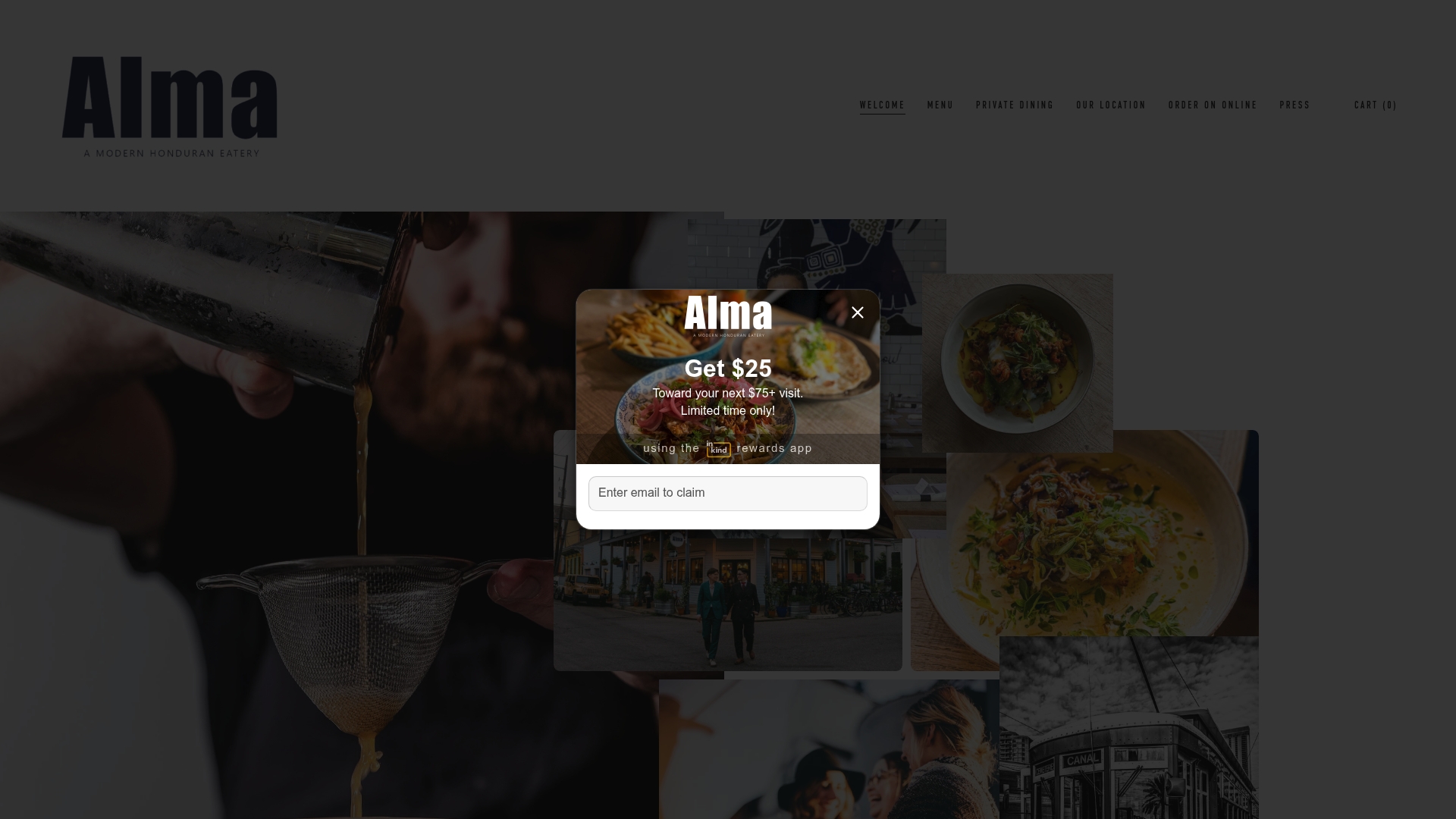
If you are planning a private gathering, a coffee-focused event, or an intimate celebration, Alma's private dining experience offers the perfect setting. The space is designed for connection, and the coffee bar is fully integrated into every private event menu. Book your private dining experience at Alma Café and bring the same specialty coffee culture to your next occasion.
FAQ
What are the main types of coffee bar drinks?
The four main coffee bar menu categories are espresso shots, black espresso and water drinks, milk-based espresso drinks, and cold coffee options. Every standard café drink maps to one of these groups based on preparation method and composition.
What is the difference between a latte and a flat white?
A latte is approximately 240 ml with a high steamed milk volume and minimal foam, while a flat white is around 150 ml with a higher espresso-to-milk ratio and thin microfoam. The flat white delivers a stronger, creamier espresso flavor in a smaller cup.
What is a coffee code menu?
A coffee code menu lists bean origin, roast level, brewing method, and add-in options for each drink, giving customers the information they need to predict flavor and texture before ordering. Omitting the brewing method is the most common gap that leads to unmet flavor expectations.
How many drinks should a new café put on its menu?
Starting with approximately six core anchor drinks and revising after two weeks based on sales data produces better results than launching with a large menu. Excessive options slow customer decisions and create operational inconsistency.
How should a coffee bar menu be organized?
Grouping drinks by preparation method or temperature, with clear category headers and ingredient-first descriptions, reduces customer cognitive load and speeds up ordering. Placing high-margin drinks in anchor positions within each category section also improves profitability.