
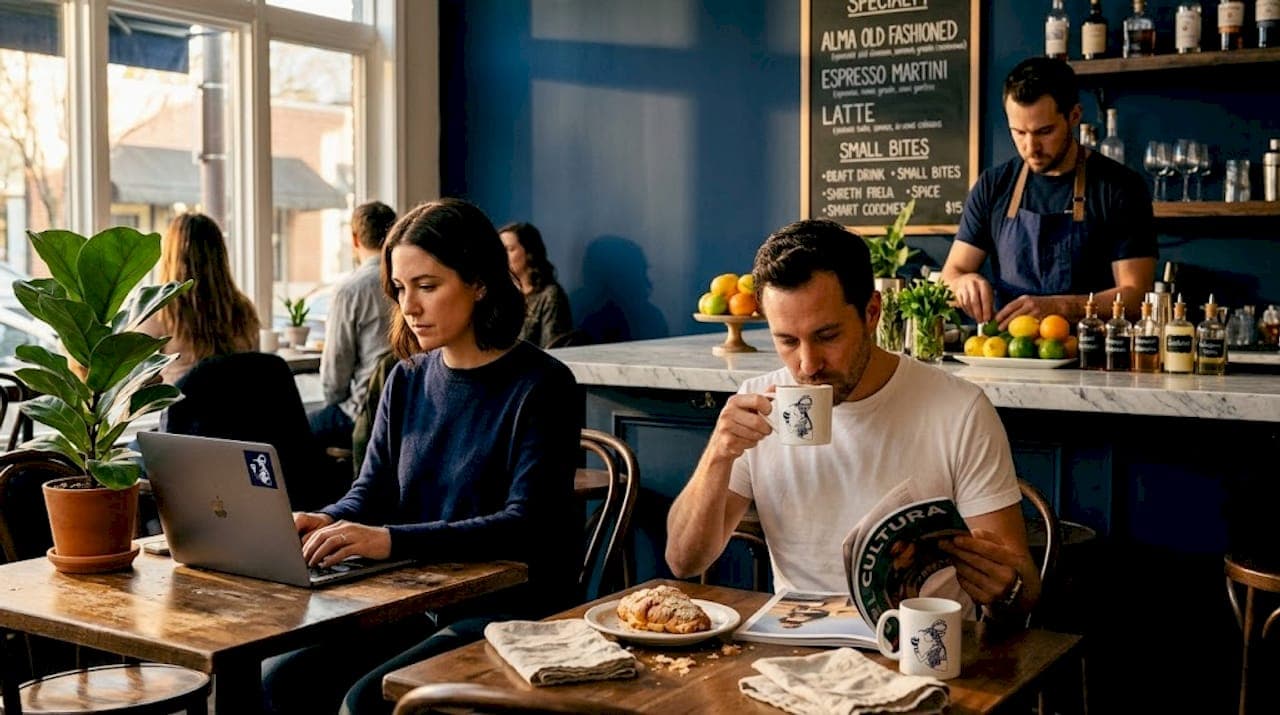
Walking into a place that serves a perfectly pulled espresso at 8 a.m. and a handcrafted cocktail at 9 p.m. is not a coincidence of design. It's the deliberate architecture of a full-service cafe bar, a concept that is reshaping how people eat, drink, and gather. Most people still picture a cafe as somewhere you grab coffee and leave. A full-service cafe bar is something else entirely, and understanding what separates it from a standard coffee shop changes how you experience every visit.
Table of Contents
- Key takeaways
- What a full-service cafe bar actually is
- The menu at a full-service cafe bar, hour by hour
- The third-space identity and community role
- How full-service cafe bars actually operate
- What to expect when you visit a full-service cafe bar
- My perspective on what makes this concept matter
- Experience it for yourself at Alma Café
- FAQ
Key takeaways
| Point | Details |
|---|---|
| Hybrid hospitality model | A full-service cafe bar blends coffeehouse and bar service under one roof, operating across 12 to 16 hours daily. |
| Table service throughout | Unlike counter-service cafes, guests are seated, attended to, and served a full menu of food, coffee, and drinks. |
| Dayparting drives the menu | Menus shift by time of day, with coffee and pastries in the morning and cocktails and shared plates in the evening. |
| Third-space community role | These venues serve as community hubs where people work, meet, and socialize beyond a quick transaction. |
| Staffing is cross-trained | Baristas and bartenders often share overlapping skills to keep service quality consistent as the day transitions. |
What a full-service cafe bar actually is
The full-service cafe bar definition starts with a simple premise: one space that operates with the warmth of a coffeehouse in the morning and the social energy of a bar by night. Operations typically span 12 to 16 hours daily, which immediately sets it apart from most cafes that close mid-afternoon and most bars that do not open until evening.
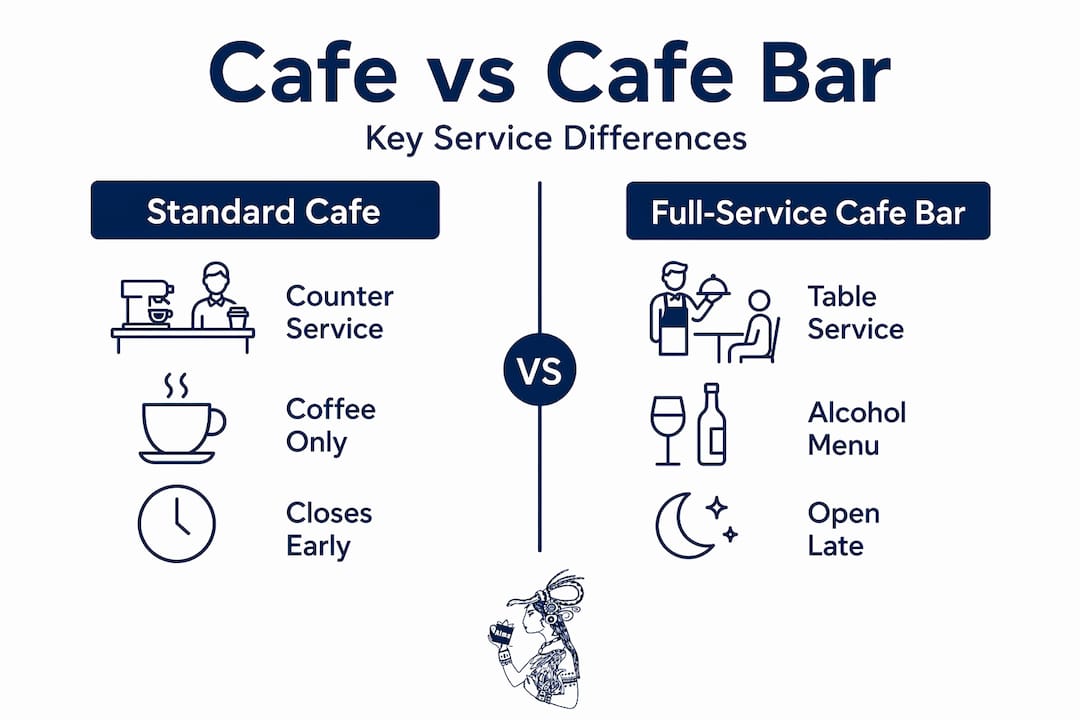
The clearest difference between a cafe and a cafe bar comes down to service structure. In a traditional cafe or fast-casual coffee shop, you walk to a counter, order, collect your drink, and find a table on your own. In a full-service environment, you are seated, given a menu, and attended to by waitstaff. Full-service restaurants require higher staffing levels including servers, bussers, and bar staff, all working in coordination rather than in isolation.
Here is what distinguishes a full-service cafe bar from other formats:
- Menus cover every daypart. From espresso and pastries at breakfast to cocktails and sharing plates at night, the menu adapts around the clock.
- Table service is standard. Guests do not queue at a counter. Staff come to them.
- Alcohol is licensed and central. Beer, wine, and spirits are not an afterthought. They are part of the core identity.
- Baristas and bartenders coexist. Some venues cross-train staff; others schedule specialists. Either way, both skill sets are present.
- Atmosphere shifts with the hour. Lighting, music, and pacing change deliberately as the venue transitions from morning to evening.
| Feature | Standard cafe | Full-service cafe bar |
|---|---|---|
| Ordering style | Counter self-service | Table service with waitstaff |
| Menu scope | Coffee and light snacks | Full food, coffee, and alcohol menu |
| Operating hours | Typically 6 a.m. to 4 p.m. | Typically 7 a.m. to 10 p.m. or later |
| Alcohol service | Rarely available | Core offering |
| Atmosphere design | Fixed | Adaptive by time of day |
Pro Tip: When scouting a venue described as a cafe bar, check whether it holds a full liquor license. A cafe that sells beer is not the same as a full-service cafe bar with a curated cocktail program and table service from open to close.
The menu at a full-service cafe bar, hour by hour
One of the most striking features of popular cafe bar concepts is how the menu functions less like a static list and more like a living document that responds to the time of day. The technical term for this is dayparting, and it is one of the most financially smart strategies in hospitality.
In the morning, the focus is tight and purposeful. Espresso drinks, pour-overs, lattes, and house-made pastries carry the early hours. You will see pastries shape the morning experience as anchor items that complement coffee and encourage guests to linger rather than rush. Avocado toasts, breakfast bowls, eggs prepared to order, and warm tortilla dishes fall into this window.
As the day moves into midday and afternoon, the kitchen expands. Salads, grain bowls, sandwiches, soups, and light entrees give guests more reasons to stay or return for lunch. Desserts appear, and non-alcoholic specialty drinks such as horchata lattes, hibiscus sodas, or flavored cold brews keep the menu feeling distinctive.
The evening shift is where the cafe bar concept truly separates itself. High-margin specialty cocktails and sharing plates in the evening are used strategically to offset lower-margin daytime coffee sales. This is not accidental. Craft cocktails carry significantly higher profit margins than espresso drinks, and combining both under one operating model creates a financially resilient business.
Evening menu ideas you will commonly find at full-service cafe bars include:
- Signature cocktails built around regional spirits or seasonal ingredients
- Natural wines and craft beers with curated selections
- Charcuterie boards, flatbreads, and small plates for sharing
- Warm entrees centered on local or culturally specific ingredients
- Non-alcoholic "mocktail" options that match the craft cocktail presentation
Pro Tip: The best cafe bar menus use the same ingredients across dayparts. A smoked meat that appears in a breakfast hash at 8 a.m. can anchor a sharing plate at 8 p.m. This reduces waste and keeps food costs manageable across long operating hours.
The third-space identity and community role
There is a term urban sociologists use: "third space." Your home is the first space. Your workplace is the second. The third space is where you go to simply exist among other people without obligation. A full-service cafe bar acts as a community hub offering amenities like free Wi-Fi, meeting rooms, and curated atmospheres that turn a meal or a drink into something more social.
This is what separates great cafe bar concepts from merely functional ones. The physical design choices matter as much as the menu. Low-lit corners for private conversation, communal tables for open interaction, bar seating for solo guests who still want energy around them. These are not decorative decisions. They are hospitality decisions.
"The cafe bar concept is inspired by tavern culture, aiming to create a third space that blurs the line between a coffee stop and a social outing. This social aspect is viewed as a necessity to foster community connections." — Resy
Neighborhoods are increasingly defined by the third spaces within them. A well-executed cafe bar becomes the place where people hold informal meetings in the morning, catch up with friends over lunch, and end their evenings with a well-made drink. The boundary between cafe and bar is intentionally blurred to create social spaces that respond to modern community needs.
Other amenities that popular cafe bar features commonly include:
- Free and reliable Wi-Fi for remote workers and students
- Flexible seating that can accommodate a solo laptop user or a group of eight
- Reservation systems for evening dining while remaining walk-in friendly during the day
- Curated music playlists that shift in tempo and energy as the day progresses
- Event programming such as live music nights, tasting menus, or pop-up experiences
How full-service cafe bars actually operate
Running a full-service cafe bar is not simply a matter of adding a cocktail list to a coffee menu. The transition of service mood is a fundamental operational principle, and it requires both physical flexibility and smart staffing.
Here are the key operational priorities that separate well-run full-service cafe bars from struggling ones:
-
Cross-training staff. A barista who understands cocktail preparation can work a longer shift across both dayparts. A bartender who respects the precision of espresso brings that same attention to mixing drinks. Blending barista and bartender skill sets is not optional in lean operations. It is a survival strategy.
-
Designing around a central bar. A central anchor bar that handles both coffee and cocktail service avoids the inefficiency of duplicated stations. One hub serves the entire floor, reducing labor costs and keeping service quality consistent.
-
Adaptive lighting and atmosphere design. The same room that feels bright and energizing at 9 a.m. needs to feel warm and intimate by 7 p.m. Dimmer systems, candles, and adjustable music volume are tools, not luxuries.
-
Managing the morning-to-evening tempo shift. Morning service rewards speed. Evening service rewards patience. Staff need to shift their mindset and pace with the room. This is arguably the hardest operational challenge, and it is the one most full-service failures overlook.
-
Menu complexity and food cost control. A menu that spans 16 hours introduces significant food prep complexity. Successful operators design menus where components overlap across dayparts and prep is consolidated to reduce both waste and labor.
Pro Tip: Schedule a brief all-hands meeting or "mood shift" moment between lunch and dinner service. Even a five-minute reset where staff change the music, adjust the lighting, and update their mental approach to pacing can visibly transform the guest experience.
What to expect when you visit a full-service cafe bar
If you have mostly frequented traditional cafes or standard bars, your first visit to a genuine full-service cafe bar will feel noticeably different. Understanding what to expect at a cafe bar removes any awkwardness and helps you get the most from the experience.
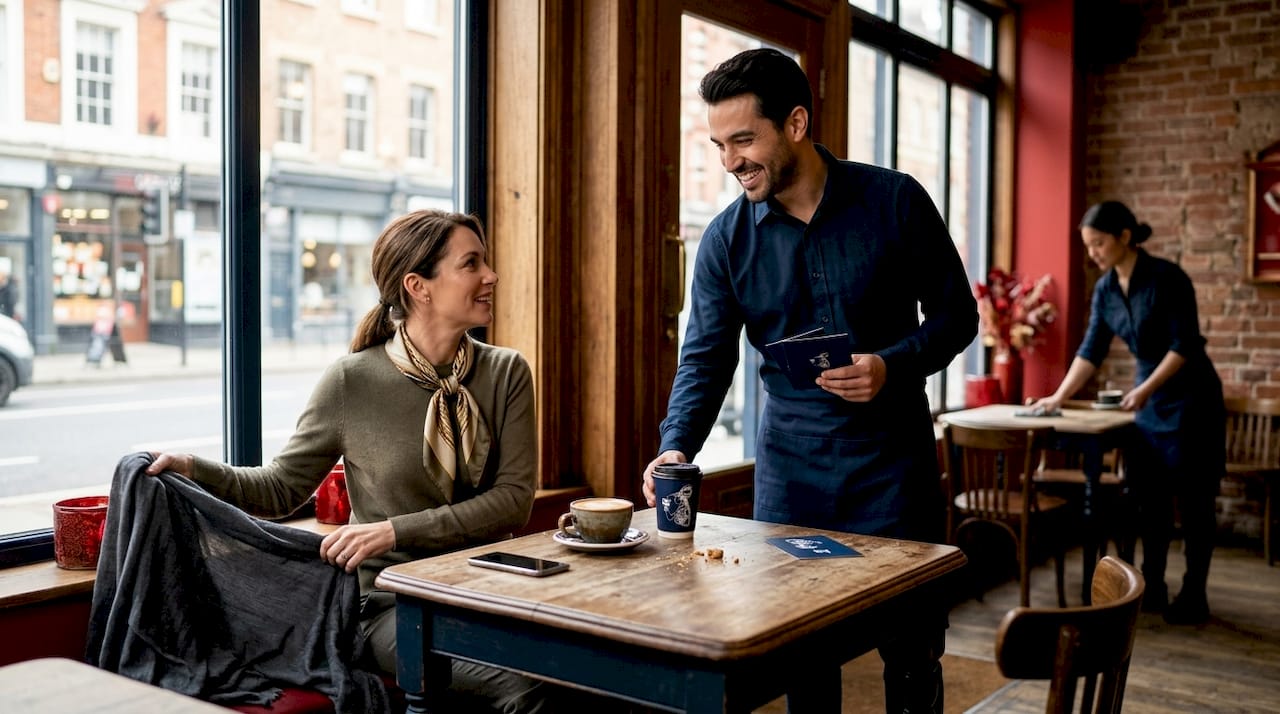
When you arrive, expect to be greeted and seated rather than directed to a queue. This is table-service territory. Your server will bring you a menu that likely covers coffee drinks, food, and alcoholic beverages all in one document, because the venue genuinely offers all of it. Do not feel obligated to order alcohol in the morning or restrict yourself to coffee in the evening. That flexibility is the whole point.
Pacing will be slower than a fast-casual cafe. This is intentional. The environment is designed for modern brunch as a social dining experience and for leisurely evenings, not quick transactions. If you are on a tight schedule in the morning, most full-service cafe bars accommodate that. But the space rewards those who slow down.
A few things to keep in mind:
- Evening reservations are common. As dinner service picks up, many full-service cafe bars shift to a reservation-preferred model. Call ahead or book online.
- The coffee bar and cocktail bar are the same bar. Your espresso and your evening Negroni come from the same service point.
- Menus change by time of day. Do not expect the full dinner menu at 11 a.m. Dayparting is part of the design.
- Service attentiveness is a feature, not a formality. Full-service means your glass is refilled, your table is cleared promptly, and someone checks in without hovering.
My perspective on what makes this concept matter
I have spent years watching the hospitality industry quietly split into two directions: venues that go faster and venues that go deeper. The full-service cafe bar is firmly in the second camp, and I think that is exactly why it is gaining traction right now.
What I find most underappreciated about this model is that it solves a real problem most people do not consciously recognize. Most people do not want a coffee shop or a bar. They want a place that feels right for whatever mood they bring through the door. Morning focus, midday catch-up, evening celebration. One space that can hold all of those without feeling like it is trying too hard.
The challenge I have seen operators struggle with is the assumption that great coffee culture and great bar culture can just coexist without intentional design. They cannot. The service consistency challenge is real. A venue can have extraordinary drinks at both ends of the day and completely lose the plot in between when staff energy drops and the atmosphere goes flat.
What I believe sets successful full-service cafe bars apart has nothing to do with the menu. It is the room reading. The best operators I have seen know how to feel when a space needs to shift, and they act on it before guests notice. That kind of attentiveness does not happen by accident. It is trained, practiced, and valued from the top down.
— Melissa
Experience it for yourself at Alma Café
If you want to understand what a full-service cafe bar looks and feels like in practice, Eatalmanola's Alma Café in New Orleans is exactly the kind of place this article has been describing. From early morning espresso and house-made pastries to refined dinners rooted in Honduran cuisine and Gulf South tradition, the space moves through the day with purpose. The full menu at Alma Café spans breakfast, brunch, lunch, and dinner alongside a craft cocktail bar drawing on Latin American spirits and tropical ingredients.
For gatherings that deserve their own space, Alma's private dining options bring the full-service experience into a more intimate setting. Whether you are planning a celebration, a business dinner, or a special occasion, it is the kind of hospitality that makes the concept real. Find your nearest Alma Café location and see for yourself what it means when a cafe bar is built around soul, not just service.
FAQ
What is the difference between a cafe and a cafe bar?
A standard cafe focuses on counter-service coffee and light snacks, typically closing by mid-afternoon. A full-service cafe bar adds table service, a complete food menu, and a licensed alcohol program, operating across morning through evening hours.
What does full-service mean at a cafe bar?
Full-service means guests are seated, attended to by waitstaff, and served from a complete menu rather than ordering at a counter. It mirrors the service style of a full-service restaurant, with the atmosphere and menu range of both a cafe and a bar.
What should I expect on a cafe bar menu?
Expect espresso drinks and pastries in the morning, light meals and specialty beverages through midday, and cocktails, wine, beer, and sharing plates in the evening. Most full-service cafe bars use a dayparting menu strategy to shift their offerings as the day progresses.
Do full-service cafe bars take reservations?
Many full-service cafe bars operate walk-in during morning and lunch hours, then shift to reservation-preferred service for evening dining. Calling ahead for dinner is a good practice, especially on weekends.
How is a full-service cafe bar different from a regular bar?
A regular bar centers on alcohol service with minimal food options. A full-service cafe bar integrates a complete coffee and cocktail program alongside a full food menu, operates from morning through evening, and emphasizes the kind of attentive hospitality you would expect from a sit-down restaurant.